
What does it mean to be truly Muslim?
Are you Muslim just because you were born into it, or is it something you’ve actually chosen?
Many people born into Muslim families may identify as Muslim culturally, while others actively choose Islam as a personal faith after exploring its teachings and principles. So… which one are you?
How much do I actually know about my religion, or even practice it? Am I easily influenced? Do I feel pressured to do things I don’t really want to do? And how do I navigate the challenge of staying true to my beliefs while also being part of a larger community?
These are the kinds of questions I’ve had to ask myself. Am I living by my values, or am I just following the crowd? I’m sure many of us who have started college or gone through university have asked at least some of these same questions.
When you enter uni life, you’re given so much freedom. You can leave class to go pray, and no one will question it. You don’t even have to turn in your assignments, and most professors won’t chase you down or care. You don’t have to show up to class. You wake and sleep whenever you want. You can skip events or walk away from situations that make you uncomfortable. It’s literally all up to you. It’s not like high school anymore.
The freedom is real— but so is the temptation.
When you’re surrounded by diverse perspectives and lifestyles, it becomes even more important to reflect on who you are. And trust me, you’ll find out.
So this chapter is dedicated to those of us navigating this pivotal stage in life. It’s a time to question, explore, and define your identity while staying grounded in your values. By reflecting on these challenges, we can better understand ourselves and make choices that align with our beliefs and aspirations.

“And whoever holds firmly to Allah has indeed been guided to a straight path.”
(Qur’an 3:101)
A Personal Reflection
I remember my late middle school to early high school days vividly. My Hooyo (mom) would constantly remind me,
“Did you pray, Kamaludin? Go read your Qur’an. You have Dugsi, Kamaludin.”
At the time, it felt like just a routine—something I did because she asked, not because I truly understood its significance or wanted to do it for myself.
I’ll admit, there were times I even pretended to pray while lying in bed, just to avoid her gentle insistence. And even when I did pray, I didn’t really reflect on my salah (prayer).
Sometimes, I rushed through it as quickly as possible just so I could get back to watching my movie, talking to my friends, or playing video games. And when it comes to my Qur’an. I wouldn’t even practice or read it until the night before Dugsi. I would try to memorize and review everything right before class.
Back then, it felt like my faith was something inherited and not something I had chosen.
The Prophet ﷺ said:
“Whoever prays Fajr is under the protection of Allah…”(Sahih Muslim 657)
But toward the end of high school, I started needing fewer reminders. I noticed the change in myself, and I think my Hooyo did too.
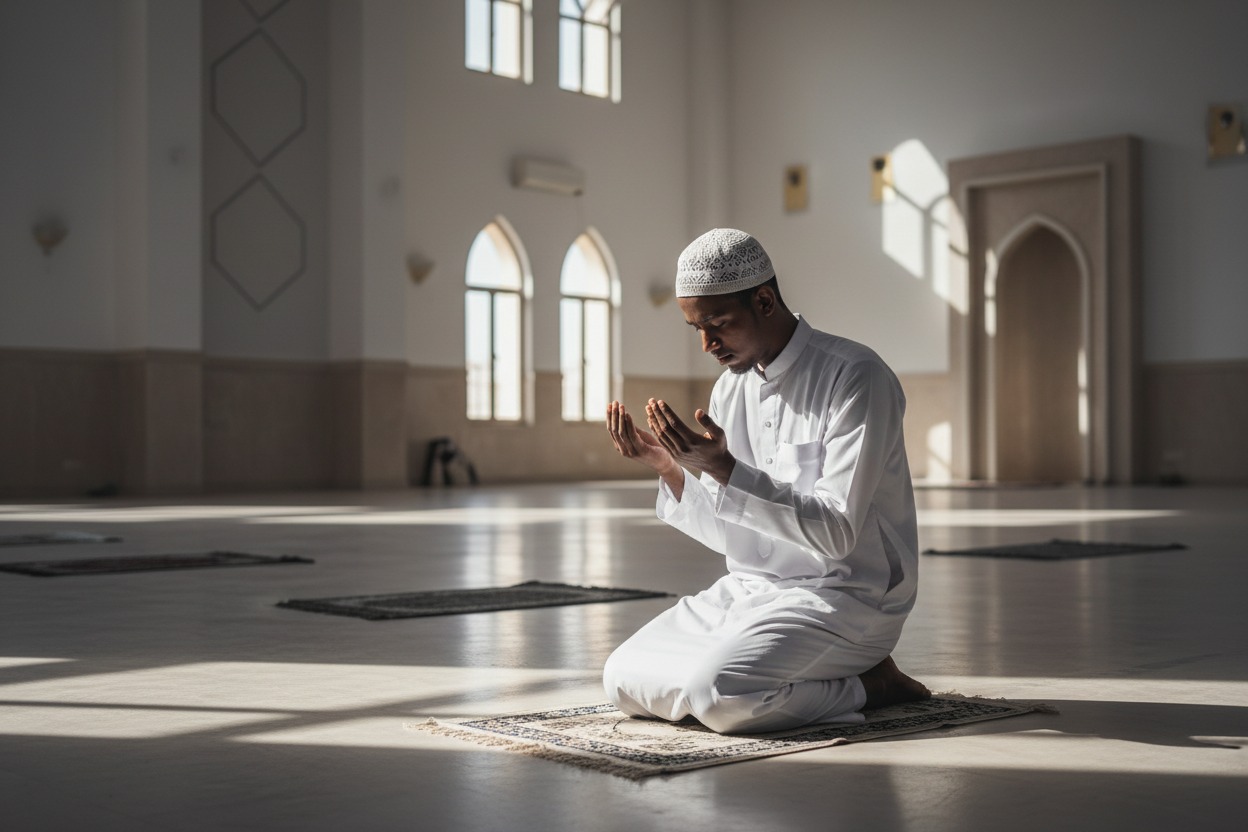
Everything changed, however, when I moved out for college. Suddenly, I had the freedom to make my own choices. I could choose to pray—or not. Read and reflect on the Qur’an—or not. And my Hooyo wasn’t there to check on me.
That’s when it hit me: I had taken those reminders for granted. I missed them more than I expected. I missed her. I missed that gentle push to stay on track.
In that distance, I realized how much I loved and appreciated my family—and how much those small nudges had really meant.
That’s when I understood: faith was always meant to be a personal journey, not just a habit passed down.
“Indeed, I am Allah. There is no deity except Me, so worship Me and establish prayer for My remembrance.”
(Qur’an 20:14)
Now, I can’t imagine my life without prayer. It’s something I choose every single day. Looking back, I see how much my mom’s persistence shaped me, even when I didn’t recognize it. Her reminders weren’t just about routine—they were about building a connection to something greater.
The Prophet ﷺ said:
“The difference between us and them is prayer. Whoever leaves it has disbelieved.”(Tirmidhi 2621)
Today, prayer is my peace. My anchor. And that journey from resistance to realization has made all the difference.
The College Struggle
Young Muslims in college often face challenges such as balancing their religious practices with academic and social responsibilities. They may encounter misunderstandings or stereotypes about their faith, leading to feelings of isolation or the need to constantly explain their beliefs. Additionally, finding halal food options and suitable places for prayer can be difficult most of the time, adding an extra layer of complexity to their daily routines.
Peer pressure also plays a big part in college life. It can lead young Muslims to feel torn between adhering to their religious values and fitting in with their peers. They might feel pressured to participate in activities that conflict with their beliefs, such as attending parties where gender mixing and alcohol is present. This struggle can create internal conflict and stress, as they strive to maintain their faith while also trying to build friendships and integrate into the college community.
Many young Muslims find support through campus Muslim Student Associations (MSAs), which they say provide a sense of community and shared understanding.
But this is not always true.
Of course, not every MSA is like this. Some are filled with sincere, practicing Muslims. But this was my experience, and it shook me.
I remember when I was in my second year of university, a friend of mine invited me to go to a Muslim Student Association event on campus. I didn’t even know that was a thing at my school, so I was excited. I thought I was about to walk into a room filled with my Muslim brothers and sisters from all over the world— sharing reminders, praying together, and showing up for each other. I felt hopeful.
But when I arrived, I was never more disappointed in my life.
It just felt like a party. Everyone was laughing loudly, chatting, eating, and that’s not the problem. The issue was the vibe. There was free mixing, casual flirting, sisters not covered properly, and brothers acting like clowns. No modesty. No reminder of Allah. It just felt hollow.
Then the time for ʿAsr came. No one cared. The event just kept going as if nothing had happened. I remember standing there, I thought to myself: There are Muslims everywhere here, and no one is praying? I was in disbelief. A whole room of Muslims, and not even the basics of Islam were honored.

“Indeed, prayer prohibits immorality and wrongdoing, and the remembrance of Allah is greater. And Allah knows what you do.”
(Surah Al-‘Ankabut 29:45)
I quietly left and found a spot to pray on my own. I believe only one other person did the same. The rest? Many weren’t even dressed properly to stand before Allah, let alone felt the urge to do so.
Later that night, I spoke with the friend who invited me. I told him what I felt — how off everything seemed. He was calm, almost indifferent. He just shrugged and said,
“That’s how everyone is, bro. They just come to interact, chill a little.”
“O you who have believed, why do you say what you do not do?”
(Surah As-Saff 61:2)
The Prophet ﷺ said:
“Islam began as something strange and will return to being strange, so give glad tidings to the strangers.”(Sahih Muslim 145)
When Faith Becomes Personal
I realized that day that not every gathering of Muslims equals a gathering of Islam. Just because people identify with the faith doesn’t mean they live by it.
That’s not judgment — that’s reality.
And I had to decide: Do I follow the crowd, or do I follow the truth?
I won’t lie — I struggled a lot. College is hard. It’s a place where your identity is tested.
Who are you when no one’s watching?
When there’s no adhan?
No mom to wake you up for Fajr?
You start to ask yourself:
Is my Islam just cultural? Just something I do when I’m around family? Or is it real?
“And We have enjoined upon man [care] for his parents. His mother carried him, [increasing her] in weakness upon weakness, and his weaning is in two years. Be grateful to Me and to your parents; to Me is the [final] destination.”
(Surah Luqman 31:14)
Looking back, I remember how much I used to get annoyed when my mom would always remind me to pray. But in college, I missed those reminders. I missed someone caring enough to push me toward Allah.
I finally understood that her love wasn’t control — it was protection. She was planting seeds that would grow later, and college was when those seeds started to sprout.
Just today, as of writing this, I called her and told her thank you. Thank you for being my mom and for everything you have done for me. Like any Somali mom, she was shocked and said,
“War maxaa kugu dhacay?” ( “What happened to you?”)
And we just laughed.
The Prophet ﷺ said:
“The first matter that the slave will be brought to account for on the Day of Judgment is the prayer. If it is sound, then the rest of his deeds will be sound…”(Tirmidhi 413)
To Any Young Muslim Reading This
Hold on. Even if no one else around you is.
Even if you feel alone.
Even if you’re the only one who leaves the room to go pray.
“So be patient. Indeed, the promise of Allah is truth. And do not let those who have no certainty of faith discourage you.”
(Surah Ar-Rum 30:60)
You were not created to blend in. You were created to stand out for the sake of Allah.
Let that be your strength.
My friend.
Check out our Instagram: https://www.instagram.com/modernmuslimstruggles/
Leave a Reply